P1 - Extreme close up of the key in the door (to his house) and (guys name) walks up the stairs. Goes into room with a wall which pitcures of suspects (mostly crossed off with red marker), newspaper cuttings/articles, maps etc with pins and string linking them. Whilst walking towards the wall he picks up a pen (red marker) and crosses off the last face. Looks at the wall and leaves to enter the bathroom, which has a cuboard (with a mirror on it) and opens it. He picks out some pills/medication and closes the cuboard. Then takes the pills with a glass of water. Stares into mirror/washes face. Gets angry and wipes desk clear/pulls down the wall. Walks down the stairs and leaves the house, when slams door shut, black screen fades to the shot of the outside. Walking down an alleyway with the locket in his hands/looking at it. He, whilst walking down an alleyway is bumped into by another man, and drops the locket. As the locket hits the floor it opens and the audience see the photo inside it for the first time (the mans wife). Shot reverse shot of the locket and the two characters faces. Main character flips and kills the other man. Camera follows the man down as he falls to the floor, and final shot becomes an over the shoulder from behind the man on the floor, with the main character walking away. Fades to black and Title is shown.
P2 - Taking influence from Se7en, we are using a duffel bag as our McGuffin by having it placed on the floor (closed) with blood seeping through onto the floor. We are seeking to establish the character of Detective Furnace, a man who lost his wife to a kidnapping and murder, along with his unborn baby dying in the process. And so vows to find his wifes murderer and bring them to justice by any means
Sunday, 17 January 2016

Location Sheet & Location Photos:
 Location Sheet: We chose these locations because they best fitted the area/surroundings that we had planned for the shooting of our thriller.
Alleyway: The alleyway we chose to look at for our thriller was chosen because it is practical, due to the fact it is rather wide and therefore is easier to shoot in than a smaller alleyway, as there is more potential for a larger variety of shots. Plus the area is relatively secluded and shouldn't be interrupted during filming. The area is also dimly lit and perfect for the lighting we want in this part of the thriller as the darkness would create connotations or enigma and mystery along with
potential for danger.


 House: We had two potential locations for the house, both in which had elements we were looking for when it came to the house in which the main character would be spending the majority of his time in during the thriller, and where the audience finds out most about him.
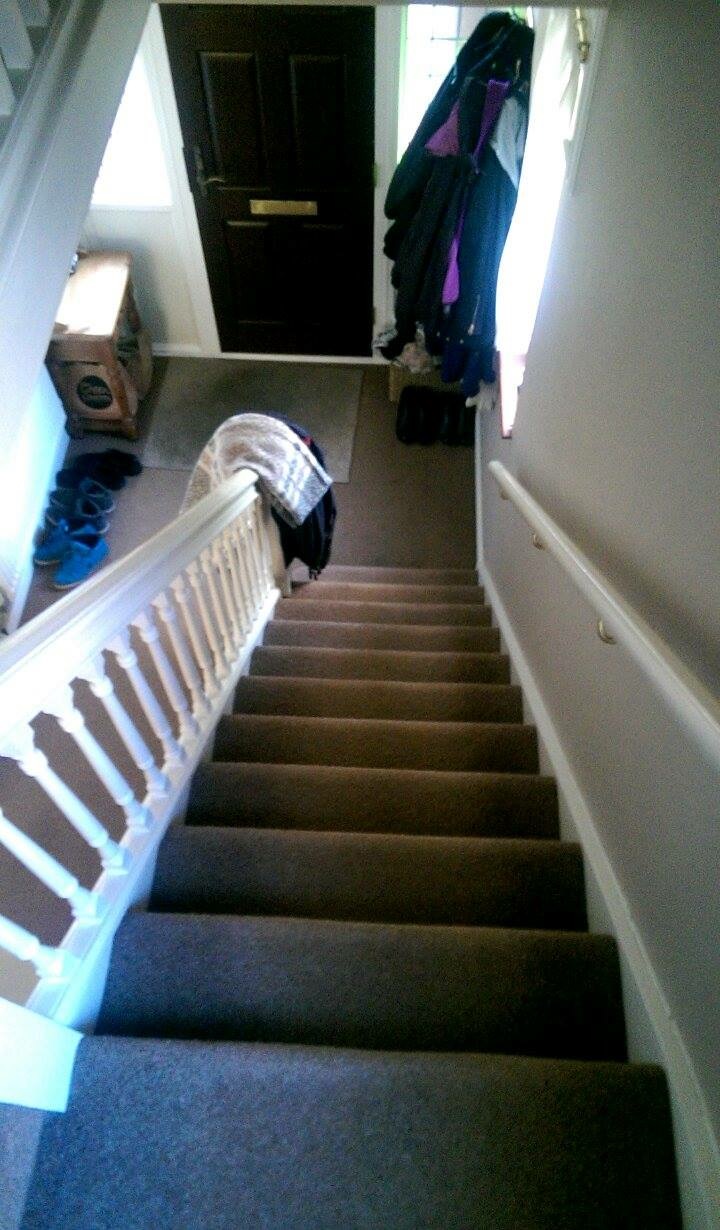 In the house, we wanted stairs with a banister, such as in the picture below, which was provided through Jamie's house (the location we decided to film in), along with a landing at the top of the stairs, the front door at the bottom and a large wall and desk in the room upstairs which is important in the thriller, due to the fact it shows a lot about the character and the story.
All of these locations fit the suburbia environment that we were looking for, as this creates a familiar environment for the audience to relate to throughout the thriller, and have the stereotypes and familiar associations of this environment challenged and changed.
Tuesday, 5 January 2016
Sunday, 3 January 2016
Tuesday, 8 December 2015
How does Double Indemnity use compositional techniques?
 |
| Figure 1 |
This creates a sense of confusion in the scene for the audience and therefore makes the shot enigmatic as it is difficult to see.
Double Indemnity also uses chiaroscuro lighting to hide the real identity of the characters through the use of shadows contrasting with the light. This is because it makes the character seem as if he has a good side to him yet is shrouded in darkness of something he has done in his life, such as committed a murder, so the shadows and chiaroscuro lighting becomes a metaphor for the darkness in his life.
 |
| Figure 2 |
In figure 2, the use of the venation blinds creates a sort of prison bars effect, which makes the characters seem imprisoned and entering a "criminal world", and could be foreshadowing this the end result (prison). The dark intense shadow from the woman in figure 2 could suggest how she is a femme fuetal character, who is leading the Walter Neff to a bad place/criminal world. The dark shadow emphasises the evil within her and how she should not be trusted.
The director of "Se7en" also uses an enigma to create tension, because the opening sequence tells us a lot about the characters and very little about the story, so the audience has no idea what will happen later on in the film. This creates tension because it keeps the audience guessing about what the plot is. The props used in the film, such as the metronome creates lots of tension because the constant, annoying sound of the ticking every second makes the audience wonder why it is used and what it is ticking for, as it could be a metaphor for time ticking down, but yet the audience don't know what it is ticking down for. This creates tension as it is an unknown quantity in the film however is clearly important.
Finally, the director of "Se7en" uses an enigma to keep the audience watching and entice them into the film. The way in which everything about the film in the opening sequence (pre-title) is mysterious keeps the audience interested in the film and why everything is as it is. In the opening sequence, we learn about how the city/location is clearly a crime-ridden city through the use of constant background noises, such as dogs barking and people shouting, or just the constant rain that is outside. This creates a constant enigma about the film which keeps the audience constantly watching as there isn't many points in the film where all is quiet and where things seem "normal", which keeps the audience on the edge of there seats wanting to find out more.
Sunday, 6 December 2015
Se7en: How does the director use an enigma?
The director of the film "Se7en" uses
an enigma to create confusion and expectation amongst the audience. The
director does this by using an opening sequence that shows many objects and
props that are made to look important yet the audience doesn't know what they
are used for or why they are there, yet expects these objects to be used later
on in the film. For example, in the shot with the knife, pen, badge and paper
rose, these are all random objects that would seem to have some meaning/use,
yet the audience isn't told what they are for or why they are there. However
this also creates an idea in the viewers mind about what Sommerset is like, but only small
parts of his personality, which creates an enigma around him. The objects
create confusion they don't necessarily
fit together as objects, and so confuses the audience as to why they are there
and whats so important about them, which again leads to the expectancy of the
objects.
The director of "Se7en" also uses an enigma to create tension, because the opening sequence tells us a lot about the characters and very little about the story, so the audience has no idea what will happen later on in the film. This creates tension because it keeps the audience guessing about what the plot is. The props used in the film, such as the metronome creates lots of tension because the constant, annoying sound of the ticking every second makes the audience wonder why it is used and what it is ticking for, as it could be a metaphor for time ticking down, but yet the audience don't know what it is ticking down for. This creates tension as it is an unknown quantity in the film however is clearly important.
Finally, the director of "Se7en" uses an enigma to keep the audience watching and entice them into the film. The way in which everything about the film in the opening sequence (pre-title) is mysterious keeps the audience interested in the film and why everything is as it is. In the opening sequence, we learn about how the city/location is clearly a crime-ridden city through the use of constant background noises, such as dogs barking and people shouting, or just the constant rain that is outside. This creates a constant enigma about the film which keeps the audience constantly watching as there isn't many points in the film where all is quiet and where things seem "normal", which keeps the audience on the edge of there seats wanting to find out more.
Sunday, 22 November 2015
How does the chase sequence and opening of The Third Man use framing and certain composition techniques, mise en scene and cinematography to create meanings, metaphors and effects.
 |
| Figure 1 |
 |
| Figure 2 |
In figure 2, the high contrast sharp chiaroscuro lighting on Harry Limes compared to the darkness around him shows how Harry is seen as a good person, however the truth about him is mostly obscure, because all we get to see about him is his face, and nothing else. This means that the audience only know his identity and nothing else, which creates an enigma about his character because all the audience can see is who he is/what he looks like. Figure 2 also uses a tilted shot, which creates a slight disorientation for the audience. The use of the tilt shot could also show how Harry Limes character is different/mysterious because the first time we see him in the film is this shot, and the shot isn't clear enough to distinct many features about him. The tilt shot adds to this because it's off balance and makes the shot even more unclear as he isn't visible properly.
 |
| Figure 3 |
 |
| Figure 4 |
Subscribe to:
Posts (Atom)